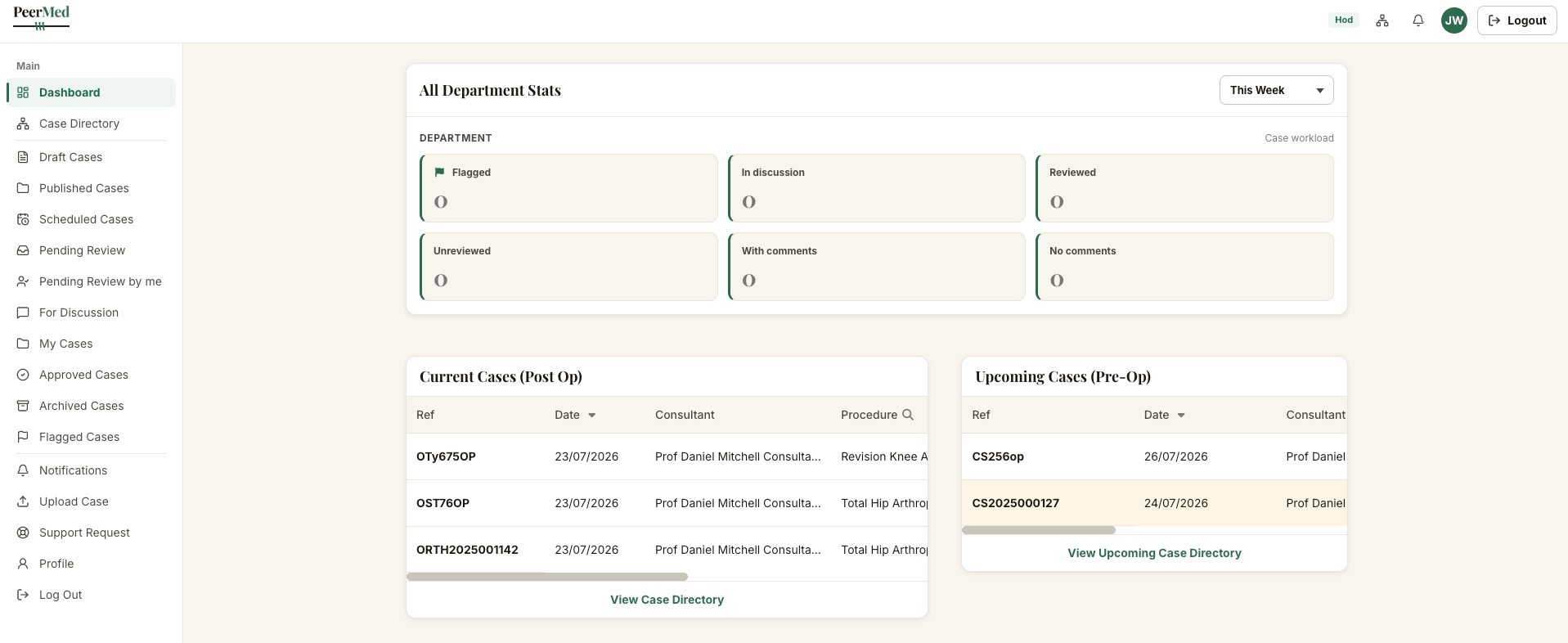
Department dashboard — case workload and review state
PeerMed is a clinical peer-review platform that lets doctors obtain a documented second opinion from senior specialists — securely, asynchronously, and with a permanent audit trail. It replaces the unstructured WhatsApp consultations most hospitals rely on with an encrypted, governance-ready workflow.
Department dashboard — case workload and review state
A junior doctor facing a complex case reaches for their phone. Scans, case histories and clinical reasoning move across consumer messaging apps. Identifiers leave the building. This is not a failure of individual doctors. It is the absence of a system.
Patient identifiers travel through consumer apps that were never built to hold them.
The hospital cannot produce evidence that the decision was ever reviewed.
The most valuable thing in the exchange vanishes when the conversation ends. The next clinician facing the same presentation starts from zero.
Four steps, each time-stamped, attributed and permanent.
A clinician creates a case using standardised clinical fields. Patient identifiers are removed automatically before anything is shared.
The case goes to chosen senior colleagues or specialists — by name or by specialty.
Reviewers respond with structured feedback inside a threaded discussion, with secure viewing of images and reports.
The case moves through formal states, each carrying governance meaning — a durable record that a clinical decision was reviewed.
Real-time consultation requires two clinicians, adequate bandwidth, and a shared free moment. In a busy ward — or a facility far from a major centre — that alignment is rare.
PeerMed removes the requirement entirely. The requesting clinician submits when they can. The reviewer responds when free. Neither waits on the other.
Structured, anonymised and labelled by procedure, comorbidity and complication, each case joins a searchable institutional knowledge base. A rare technique attempted once becomes knowledge the whole institution can reach. Clinical judgment that would otherwise leave with a departing consultant stays behind.
Over time this corpus becomes the foundation for AI-assisted triage, similar-case retrieval, and clinical decision support — trained on the institution's own patient population rather than an imported one.
What runs in production today, and what is being built.
The institutional case and the clinical one are different arguments.
| Documented clinical governance | Every reviewed case becomes evidence of a functioning peer-review process — the record accreditation bodies look for. |
|---|---|
| Reduced preventable harm | A structured second opinion before a high-risk decision catches what a solo clinician can miss. |
| Compliant by design | PHI de-identified at source, encryption in transit and at rest, RBAC, and a complete audit trail. |
| Institutional memory | Clinical experience is captured and retained rather than lost to staff turnover. |
| Defensible record | If care is ever questioned, the institution can demonstrate the decision was reviewed. |
| Deployment flexibility | On-premise or private-cloud options for data-sensitive institutions. |
| A second voice | No high-stakes decision made alone, regardless of shift or location. |
|---|---|
| No scheduling friction | Submit at 11pm; receive senior review by morning. No appointment, no call. |
| Protection through documentation | A record showing due diligence was exercised. |
| Accelerated learning | Junior clinicians learn from reasoning, not just outcomes. |
| Anonymous contribution | Reviewers can give candid feedback without hierarchy interfering. |
We publish these deliberately. A platform that claims no constraints is a platform nobody has stress-tested.
Designed for decisions with hours or days of latitude: pre-operative planning, post-operative review, complex diagnostic questions. Never a substitute for on-site emergency escalation.
Too few active senior reviewers in a specialty produces slow or thin responses. Deployment should begin where reviewer depth already exists, then expand — not launch across all departments at once.
PeerMed sits inside a medical staff structure. Without a department head or medical director sponsoring adoption, it becomes another underused system. An organisational commitment before a software purchase.
PeerMed handles the peer-review layer specifically. It is designed to integrate with existing hospital information systems — and that integration is on the roadmap rather than live today.
Reviewers provide a professional second opinion; they do not assume a doctor–patient relationship with the remote patient. Institutions should confirm this model against their own indemnity arrangements.
The platform provides the technical safeguards — de-identification, encryption, access control, audit. Compliance and data-governance authority remain with the deploying institution.
In production with hospital clients in Europe, running the full peer-review loop: submission, anonymisation, review, discussion, formal approval. Further deployments are in discussion across South Asia and North America.
Laravel — REST API architecture, JWT authentication
ReactJS
REST microservices with service isolation
PII/PHI anonymisation at submission; encryption in transit and at rest
Role-based access control with full audit logging
Cloud, private cloud, or on-premise
Designed for EMR/HIS integration via secure APIs
In production · hospital clients in Europe
Thirty minutes, screen shared, with a clinical lead in the room. We'll walk one case from submission through anonymisation to formal approval, and show you the audit trail it leaves.